Tuesday, April 26, 2011

Global & New Media


Above, it is true that there are unique technological capabilities to our historic era. Media communication has increased in accessibility and reach but it is also part of a larger transformation of globalization. Globalization is a process: the integration of economic, political, cultural and technological systems across the globe. Almost every historic era has an example of global expansion and aims but in our historical moment there is an emphasis on technological and economic unification by peaceful means.


Defining global media involves reaching the widest possible audience. The media formats above fulfill the following: multi-lingual, multi-platform, and global access (mainly foreign presence). Below the Coca Cola commercial uses almost no words in order to reach the widest audience but its use of faith based symbols is replaced with the corporate logo, suggesting people are now unified through products or more so capitalism.


Above Hallin & Mancini conclude their analysis of European media by suggesting a convergence of values and decrease of differences. The problem suggest the authors is that differentiation is important to media, not just in country of origin but in different value sets. The issue is complex because previously people used to get information from different sources and the source could suggest something about the reliability of the information, now with new media there is an abundance of information and less differentiation.


Below Jean Baudrillard felt the contemporary moment was a battle of the Global and the Universal. The global was a market driven, democratic capitalist agenda to unify the world through materialism that could be symbolized by something like Levis jeans, which are everywhere. The universal was the original value of existence, even beyond earth that unifies us all and is a mysterious and undefinable source of respect for one another. This second aspect is decreasing as the focus becomes more about life on earth and its improvements.


Baudrillard also suggested that with globalization, manufactured destiny was the opposite of culture as destiny, that we are born in a context that is forever who we are. Yet in our contemporary moment, globalization overrides differences between cultures and thus obscures individual purpose. Above left Germany at Epcot and right Germany. Kafka had a similar concern as he expressed that his grandfather told him, "I do not see how in one lifetime there is enough time to leave your village." Below 24 hours of contemporary global plane travel today. See it in motion here.


Above ancient telephones with recent history, the iPhone 3. New media is a growing category of media forms with: interactivity, interconnectivity between devices and global reach. Importantly this has changed information from going one direction to the receiver to being a shared dialogue among users.


Above the types of new media and their values. Below some of the European new media such as Skype from Estonia, Tuenti from Spain and Skyrock from France. Pikanews is a European based new media content aggregator that indicates how much new media activity happens in any topic.


New and especially social media appears to be having widespread consequences on daily behavior. Psychologists are now treating behavioral disorders related to new media, such as email checking anxiety. See the full story here and a academic lecture on the topic here. What psychologists believe is that there has always been a degree of privacy and discretion which no one could access. That private psyche is now becoming more transparent.


Above, Wim Wenders 1987 film Wings of Desire gave access to people's private thoughts, see full video. Now with Twitter we advertise them.


Above the strategic use of Twitter to advance corporate relations or network. Below the question of globalization and new media together is the increasing collective consciousness that is developing. However with only 20% online it is not a full picture.


Above many think of the aim of global new media as simply increasing our screens of entertainment while there is much greater potential for information and education. Estonia used new media forms politically for the previous election though some argues this favored votes by those with internet access, even though the country created public internet voting stations.


In looking back at the past century in France and Europe, the old ways of life, conflicts and machines developed more slowly than the US. The question is how France and Europe will continue to embrace developments and take part in the global digital community.

Wednesday, April 6, 2011

News Corporation Imperialism

by JJR


The European Union, officially founded in 1993, unites 27 European countries under a common currency and acts as a unifying body for the greater Europe. Among their political duties, the EU strives to foster a European identity that complements the national identities that many citizens hold. Of course television is part of this formation of identity, and European television calls into question Habermas' Public Sphere. This concept speaks to the greater public opinion that is formed when individuals come together to reach a consensus on something. European television is a sensitive medium because Europeans, especially in France and Italy, have a very keen cultural awareness and do not like foreign media agendas proliferating their countries. Fortunately, Rupert Murdoch's giant media conglomerate, News Corporation, is aware of this and uses this idea to market to niche audiences in Europe, and uses a business model that is somewhat contrary to the framework of cultural imperialism that has been the norm for these conglomerates in the past.

France and Italy's populations combined is 122 million, about a quarter of the EU's total population, and certainly more than a fourth of the television viewing audience. That said, these are lucrative outlets for a company like News Corporation to take advantage of, but instead of pushing a huge American brand like Fox, they are very culturally specific. In France, the Voyage network features programs which center around French cultural activities, with two examples being Prenez l'Air and La Mer en Face (*see links below). In Italy, the Cult network provides independent films and series only in Italian. Cult is for a sophisticated viewer, and is reflective of Italy's history of elite media.

In conclusion, in is News Corporation's cultural sensitivity that has allowed them to be so profitable and expansive in the European market. Of course American content is available almost everywhere in Europe, but the availability of alternative media is what sets News Corporation apart from its competitors. In today's media climate, it may not be as appropriate as it once was to talk about media as completely imperialist, and maybe the conversation will start to adapt to new models of transnational media in which the cultures to which the content is being sold is really the key to success.

›


Tuesday, April 5, 2011

French Music & Fashion Media


France has long treated radio as a tool of communication, to inform citizens and provide news. Above the French sponsored RFI covers global issues and is available in other languages in other countries. Below the private owned Europe 1 is based in France and hosts numerous radio talk shows along with entertainment.


Above popular French radio FIP, NRJ, Nova and Skyrock and Radio Free Europe, an American initiative in Europe. Below the European Broadcasting Union is a private alliance of global participants. Eurosonic is their radio support network and contest.


Below the EBU's famous annual song contest Eurovision.


American musician Joel Cohen and France Music started the Fete de la Music on June 21 each year.


France's hip hop production leads the world, second only to the US. Below globally recognized French rap artist MC Solaar.


Above the French electronic musicians Daft Punk, Air and Dave Guetta. Air is from Versailles and were said to have encouraged the development of the French indie scene with Phoenix. Below also Curry & Coco and Pony Pony Run Run.


Below France now supports an official state school for training DJ's, more here.


Above French fashion media from magazines, to television to websites. Below the origin of the fashion magazine was aristocratic journals like Mecure Galant leading to the luxury Gazette du Bon Ton in the early 20th century.


Above the Lanvin Show in 1961. Modern media began to advance fashion. Slowly the world knew about the well known fashion circuit of shows in New York, London, Milan and Paris. Media helped build up fashion culminating in our postmodern moment when media is now an authority over fashion and style.


Above, the extreme surrealist and unusual fashion ads of Galeries Lafayette in Paris. Below the integration of fashion throughout French society as it is included in regular news, talk shows public ads and graffiti more commonly than in the US.


Above Fashion TV is the only network devoted to fashion 24/7. It was founded in Paris by investor Michel Adams and includes events and products. The channel shows instant broadcast of fashion shows but has been criticized for its other content being more about models than fashion. Below fashion journalists take the clothing more seriously. The world's most significant fashion journalist is based in Paris, Suzy Menkes. The rise of fashion blogging challenges established media. Center the Satorialist and right his French girlfriend fashion blogger Garance Dore.


FRENCH MUSIC AND FASHION MEDIA


12" As a Medium Techno: From Youth Culture to Cultural Constitution
Lily Galef


This article, published in Nettime Magazine in 1998, attempts to trace Techno music from its origins as a 'fad' in youth culture to what the author, Mercedes Bunz, terms 'Cultural Constitution'. Bunz asserts that because Techno was regarded as a fad, it was not given attention and therefore was able to grow into a part of society. The most unique aspect of techno, which Bunz uses as evidence that it has become a cultural constitution, is the fact that the artists are insignificant. Techno music is not a medium through which individuals can express themselves, it is pure art, with "no perpetrator behind the art".


Key Terms:
"Hiding in the Light": termed by Dick Hebdige, referring to the phenomenon of Techno being regarded as a fad, which actually fostered its growth into a cultural constitution.
Cultural Constitution: Techno being a 'cultural constitution' implies that it has become a part of society. It bridges the gap between highbrow culture and subculture and "offers us a new view of culture".

Mallarmè and La Dernier Mode

Lily Galef

This scholarly book, written by P.N Furbank and Alex Cain, is a translation of the Fashion Magazine La Dernier Mode, which was written, edited by, and created by Stephane Mallarme. The introduction, which we read for today, gives a brief summary of Mallarme's literary career and then mainly focuses on La Dernier Mode. He is mainly known for being an ironic and enigmatic poet in search of "l'oeuvre pure, yet the focus of this book is on his much lesser known work with La Dernier Mode. The book poses the question of why, "such a work of genius has received very little attention". The only other scholarly work on this subject noted by these authors is Jean-Pierre Leclercle's Mallarme et la mode, published in 1989.


Mallarme was the main contributor for the fashion magazine, yet he wrote all of his articles under different pseudonyms. The authors here discuss his love of decorative art, yet his strong criticism of its inability to innovate in his time. One of the most interesting aspects of this introduction is the comparison the authors make between Mallarme's interpretations of fashion and those of his contemporaries. The three main contemporaries are Gautier, Bauldelaire, and Barthes. The most interesting contrast made by these authors is how the these three poets were simply critics of fashion, whereas Mallarme explored it from the inside.


The concluding paragraphs of this chapter discuss Mallarme's motivations for starting the fashion magazine. The authors analyze Lecercle's interpretation and conclude that it is half right in its assumption that he created the magazine to "create a desperate hunger for poetry". The authors also analyze Dragonetti's interpretation that Mallarme's creation of La Dernier Mode had nothing to do with fashion at all, but had deeper literary meaning. The authors conclude that this interpretation is wrong, and biased by Dragonetti's disbelief that Mallarme could possible be interested in fashion. What struck me most about this chapter was the implication that fashion is something modern and intellectual that is worth analysis by some of the greatest minds of the nineteenth century.

Key Terms:
"Paradox of the New": The concept that fashion changes each year, yet stays the same within that year.


Monday, April 4, 2011

FRENCH MUSIC & FASHION MEDIA

by Jolie Spellacy

"The Secret World of Serge Gainsbourg" by Lisa Robinson

The overused cliché “you either hate it or you love it” does not apply to the late Serge Gainsbourg. Not because people were impartial about the man, but rather he was just of those guys that everyone loved. Whether it was the local police, taxi-drivers, music-lovers, or his own family, everyone loved Gainsbourg. As a musician, he was a genius. His arresting lyrics and voice quickly made him an icon in the music world, but it was his do-good personality that made him an icon of French culture.


Graffiti scrawled on Gainsbourg's home


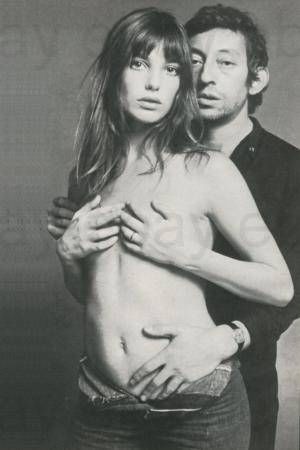
The Vanity Fair article “The Secret World of Serge Gainsbourg” summarizes the iconic Gainsbourg’s personal life. Gainsbourg was a known womanizer and went through many relationships, the longest lasting 13 years with Jane Birkin. He was not particularly good looking, but made up for it in intelligence, sophistication, and wit. The man was one full of contradictions. He was shy, but very open, especially when he told Whitney Houston that he wanted to “f*ck” her on national French television, (for the Youtube clip click here). He was a sex god of sorts, but many of his lovers never saw him fully nude. He was “selfish in ways an artist can be, but there was no snobisme.” And unlike most other rich Parisian socialites, he did not evade taxes. The article depicts Serge Gainsbourg as truly strange, interesting, and exceptional man.


Gainsbourg and Birkin


Serge’s closest friends, who are, more or less, interviewed throughout the report, all told insightful stories of their lost friend. His daughter, Charlotte, hopes to turn his old apartment into a museum for people to roam around freely in and learn who her father really was. Charlotte’s mother, and Serge’s ex-lover, Jane Birkin, told a story of grandiose love and a truly stereotypically chic, Parisian lifestyle.

The article quotes Nicolas Godin and Jean-Benoit Dunkle, two popular songwriters, as comparing the day Gainsbourg died to the deaths of President Kennedy and John Lennon for Americans, stating that the French will always remember where they were when they found out he had died. Gainsbourg reached his iconic status to the French collective through his portrayal in the media. As the article states, Serge Gainsbourg was one of the most loved people in France.


Click here to listen to his infamous song with Jane Birkin "Je T'aime... Moi Non Plus" which was banned by both the BBC and the Vatican for explicit sexual content. This also is the song used in the most recent commercial for Miss Dior Cherie staring Natalie Portman.

"Over to You: Writing Readers in French Vogue" by Agnes Rocamora

The April 2011 issue of French Vogue

In this article Agnes Rocamora analyzes the readers’ letters published in French Vogue between March 1996 and December 2001. Rocamora’s argues that through studying the readers’ writings she gains insight into the way Vogue defines itself. According to Rocamora, the letters page is a platform for Vogue to represent itself and convey its ideals as well as demonstrate how it would like to be perceived by its readership.


The letters section as a democratic platform for the public sphere:

Rocamora establishes the magazine as one of the mediums of the Public Sphere, arguing that the readers’ letters page encompasses the notions of the Public Sphere more so than any other section. Ideally, “La Parole est a Vous” (Over to You) segment would serve as a democratic platform for the readers to express genuine public opinion. However, the editorial process of choosing, editing, and allegedly fabricating letters challenges the validity of the magazine as a function of public opinion. Today, the press is no longer viewed as a “mediator and intensifier of public discussion” but rather “the medium of a consumer culture”.


Jurgan Habermas - the theorist behind the public sphere


Rocamora explains that women’s fashion magazines are considered low status because of the depiction of frivolous entertainment rather than serious, hard news. The letters page asserts the magazine as a platform for not only the discussion of material objects and appearances, but also as a stage for critical debate and public opinion. Through the letters’ page Vogue constructs its readership as active thinkers, masking its low status through encouraging “democratic energies” of expression. In addition, by publishing readers’ criticism Vogue shows that it is open to all debate, further emphasizing its democratic qualities.


While Vogue prints critical letters, it weakens their validity by juxtaposing them with letters of contradictory content. In other words, if a reader objects to the promotion of fur, another letter laments the absence of fur in Vogue. The magazine also defends itself against such objections by emphasizing its capacity to promote dreams among its readers. Vogue wrote in March 1997 that its vocation “is to show dream clothes on sublime women”. Rocamora argues that the readers’ letter section also establishes loyalty and intimacy between the readers and the magazine as well as continuity. In each issue “the past of Vogue is always present, carried from one issue to the other through the readers’ page”.


French Vogue promoting fashion as high art:

Rocamora explains that because fashion is generally considered to be a “minor art” rather than a high art, fashion magazines are deemed to be of low status. French Vogue combats this status through its endorsement of fashion as a high art. Vogue positions fashion as a high art through juxtaposing fashion images and writings with articles about high culture and “noble” subjects like the sciences or philosophy. In the letters section, this “melding of realms” is reproduced through the inclusion of letters on high culture topics like ballet. Through the insertion of high culture Vogue asserts itself as a serious medium. The readers’ letter page also demonstrates the readerships’ knowledge of high culture and its economic capacity to experience it. Through the inclusion of the “La Parole est a Vous” section Vogue bridges the distance between the text and its audience “through the enlightened discussion that takes place between the two”.


Sylvie Guillem, a world famous ballerina, poses for French Vogue


In French ideology high culture is deemed prestigious as well an indication of wealth. Vogue’s celebration of this concept of culture can be seen through the numerous readers who praise Vogue for its intelligence, further legitimizing Vogue as a serious magazine. Vogue also recognizes the importance of literature in French culture. The publication thus pays particular attention to the written text and promotes its reputation through its respected writers.


Vogue’s Parisian identity:

Paris is the location where “high culture, high class, and the high social classes meet”. Thus Vogue expresses its allegiance to Paris through addressing its reader as “la parisienne” rather than “la francaise”. Vogue strives to equate itself with Paris as a way to further establish itself as a serious publication focused on the high art of fashion. As Rocamora explains, “in Vogue ‘here’ means Paris”. Of the readers’ letters, the most represented city is Paris, further stressing the connection between French Vogue and Paris.


Carine Roitfeld, former editor of French Vogue and icon of "la parisienne"